Monday, January 14, 2013

Migrant Workers - Part 3

Before I start, please check out "Who chases workers up cranes?" by Yawning Bread on how the officers from the Singapore Ministry of Manpower handle complaints from 2 foreign migrant workers. Below are extracts from Yawning Bread's "Who chases workers up cranes?".
"The two men thought that not only were the deductions unjust, it was absurd that they had not been told of this before.
They went to MOM to lodge a complaint about the owed salaries, the unannounced deductions and the net effect of  negating their claims. The officer at MOM told them to bring documentary proof."
As Yawning Bread remarked, Acting Manpower Minister "Tan Chuan-Jin said in his Facebook post that “MOM requires documentation from workers in order to substantiate their claims”, but he seems ignorant of the power imbalance between low-wage  (especially migrant) workers, and employers."
------------------------------

Let us look at how a case of alleged illegal collection of employment fees is handled in Alberta, Canada. For more details of the case, please click here (Director of Fair Trading order) and here (Appeal Board decision) for documents from Service Alberta, Government of Alberta. [I suggest reading the Appeal Board document for the fuller story of investigations involved.]
Note: In Alberta, Canada, it is illegal for any business operator to seek any fee, reward or other compensation from a job applicant. [See "Legislation" section of the Director of Fair Trading order for details.]
Below is a brief of what happened according to the above Service Alberta, Government of Alberta documents.

1. Albera Ltd (a.k.a. Mabis Recruitment Agency) operates as an employment agency business by the sole director AC and the representative VV of the company.

2. Mabis recruited and arranged for temporary foreign workers (TFWs) to work as food counter attendants at a Tim Horton's franchise in Edmonton.

3. Mabis obtained the visas and airline tickets for the TFWs who, after arrival, worked in the said franchise. The franchise owner reimbursed Mabis the cost and quoted recruitment fees.

4. Some of the TFWs complained to Service Alberta that Mabis collected employment fees from them.
"A number of foreign workers filed complaints with Service Alberta that monies were paid to the Appellants, or their agents, in Korea or by electronic funds transfer to the Appellants [Mabis et al] in Edmonton. ... Service Alberta had opened 24 files based on separate complaints against the Appellants [Mabis et al] for receipt of funds contrary to the regulations of the Act which were not paid back to the Complainants." - extracted from Paragraph 17 of the Appeal Board decision.
"The Complainants who gave evidence were not sophisticated individuals. They came from overseas to work in Canada for minimum wage, a good portion of which is sent back to their families in the Philippines. The monies that had been charged varied from $700 to over $5,000, with most being in the $1,5000 to $3,000 range. This equates to a significant sum of money for these individuals who are faced with the rules, regulations and processes of a foreign country (Canada), all of which would be daunting to anyone unless they felt strongly about their situation. The Complainants giving evidence at the appeal hearing also indicated that, while they thought that the payments made to the Appellants were payments of fees for getting a job in Canada at the time, they were prepared to make those payments to get employment in Canada. It was only after they learned that those payments were illegal under the Act, that they filed the complaint against the Appellants." - extracted from Paragraph 18 of the Appeal Board decision with emphasis added by WD.
5. The complaint resulted in investigations by Service Alberta leading to the Director of Fair Trading order to Alberta Ltd (a.k.a. Mabis Recruitment Agency), AC and VV to
"immediately stop demanding or indirectly demanding or collecting a fee, reward or other compensation from a person who is seeking employment, or for securing or endeavouring to secure employment for the person." - extracted from the Director of Fair Trading order.
6. Mabis and its operators appealed against the Director of Fair Trading order.

7. As common with such dispute cases, there are situations of "your word against mine". The Appeal Board investigators report supported the TFWs claims as follow [extracted from Paragraph 19 of the Appeal Board decision with emphasis added by WD].
"a. Lawyer for the Appellants indicated that the Complainants conspired to cause problems for the Appellants yet the large number of complaints (47), most of which are still overseas, does not support this conspiracy theory."
"b. The documents that were signed by the Complainants, indicating that they were given their money back in cash, was acknowledged to be signed by the Complainants, however, the Appeal Board accepts their explanation that they feared that if they did not sign the document, they would not get employment in Canada."
"c. The Appellants indicated that they had no agents overseas, yet, the investigator's report indicates that there are emails that seem to contradict that."
8. There was also attacks on the (Complainants) TFWs credibility of giving evidence under oath because 2 of them had produced "resumes that contained inaccurate representations of work experience". "The Appeal Board finds that the puffery that the Complainants acknowledged in their resumes could not be equated to the evidence that they gave at the hearing under oath and accepts the Complainants explanation as truthful." -- extracted from Paragraph 20 of the Appeal Board decision.

9. Paragraph 22 of the Appeal Board decision with emphasis added by WD.
"When taking all of the evidence into consideration, the Appeal Board viewed the arrangement as being in the control of the Appellants. The Appellants could easily have avoided this controversy by opening a trust account with a chartered bank and having all money pass through that account with the use of cheques or traceable money orders, but they chose not to. The Complainants did get some benefit in coming to Canada, but they are not becoming wealthy by doing the work they do. On the other hand, the Appellants would seem to be benefiting much more and on the balance of probabilities, the evidence of the Complainants is preferred."
10. The Appeal Board ordered witness fees to be paid to the complainant witnesses (TFWs).

------------------------------

If you read stories from H.O.M.E., TWC2, and foreign labour related entries from Yawning Bread [click here or here for examples] or TheOnlineCitizen, you would know that unscrupulous agents and/or employers exploiting the ignorance and imbalance-in-power of temporary foreign workers to make money off their backs exist in Singapore.

You will also note the huge differences in the handling of complaints from temporary foreign workers (TFWs). For example:
IMHO, Singapore should hang its head in shame given its claims of a wealthier government and more efficient bureaucracy. Especially in this case, where instead of enforcing the Ministry of Manpower's "Labour Court" ruling that was in favour of the TFW, its officer recalled the TFW to the MOM office to subject him to another round of interrogation.

Some may say, it is easy in the above Canadian example for action to be taken against a small-to-medium-sized private business. Now, what if the party involved is a large and/or government-linked organization (e.g. SMRT Corp)? We shall see in the next instalment (part 4).

[Note: Click for the previous part 1 and part 2 of this "Migrant Workers" series.]

------------------------------

I would just like to add a few postscript notes for people who may be seeking employment in Canada.

1. Do not trust someone on the basis of him/her being your own countrymen
I happened to know a bit of information about the couple involved in the Canadian case above. AC is the husband of VV. AC originated from Singapore (born-and-bred Singaporean) and VV originated from The Philippines, before they migrated to Canada together. The main group of TFWs that they collected fees from were Filipinos. [Yeah, VV's fellow countrymen.] 
Let's just say that I had been proposition by some Singaporeans (based in Canada or elsewhere) with various schemes/plans when I sought to build a network of contacts during the period of my transition to Canada. Be careful of people giving you free business or investment advice/suggestions. Analyze things carefully and independently, or the freebies may end-up costing you more than you realize. I am glad that I took the conservative path and avoided committing on any major business or financial directions/transactions until I gathered independent sources of data/information.
2. Use of look-alike or sound-alike names to piggyback on famous brands
Some Filipinos reading this would recognize "Mabis" as a well-known and reputable Filipino recruitment agency. But the Mabis Recruitment Agency (a.k.a. Alberta Ltd) is totally unrelated to the well-known MAB Int'l. Services Inc. (MABIS). Too many people have a tendency not to "read the fine print" and rely on their own inferred association rather than checking the reality. Sometimes such association is harmless, but other times (as shown in the case above) it may cost them heavily.
There are also similar brand rip-offs in Singapore. Sometimes the rip-off may just be that of piggyback on a famous name association without the malicious intent. Nevertheless, it may confuse people who rely on their own inferred association rather than checking the reality. E.g. My friend LC (who was born in Hong Kong, graduated from Ireland and worked in London before relocating to Singapore with his British wife) actually thought that sending his sons to Eton House in Singapore would be akin to sending them to famous Eton College in U.K. where Prince William studied. Even after I told him that they are not related, he still liked the sound of his sons having attended "Eton". Fortunately, it so happened that LC and his family left the little red dot before his sons reached school age.
Canada's immigration and visa regulations are transparent and accessible online. If you plan to work in Canada, please check the facts out for yourself from the Canada Immigration and Citizenship website instead of relying on hearsay. It takes some effort on your part, but it may save you lots of potential heartache.

Friday, January 11, 2013

Migrant Workers - Part 2

As mentioned in my previous blog post (Migrant Workers - Part 1), Canada's 0.9% of temporary foreign workers with respect to its population is significantly lower than Singapore's 23.8% (or 18.0% Work Permit holders). 

Despite the relatively low levels of temporary foreign labour in Canada, rules stipulating the terms and conditions of such employment are very tight. Let us take a look at the live-in caregivers (a.k.a. domestic maids in Singaporean lingo) for example. 

------------------------------

(A) CANADA'S REGULATION

Canada has very strict and detailed rules regulating the employment of live-in caregivers (a.k.a. domestic maids). [Click here or here for more.] In fact, every potential maid employer needs to submit an application to the Human Resources and Skills Development Canada (HRSDC) to justify his/her need for a maid. [And I personally know of a case where the potential maid employer's application was rejected.] 

Thereafter, the "HRSDC/Service Canada officers assess the Labour Market Opinion (LMO) application and all mandatory accompanying documentation and the employment Contract." Yes, the employment contract prior to employment is mandatory. Click here for the template to see the level of details on the terms and conditions of employment. E.g. Place of work, number of rooms and bedrooms, household members, specific person requiring care - i.e. child, elderly, disabled person in the household, work-hours per day, daily work schedule, number and duration of paid/unpaid meal/health breaks, days-off per week on which days of week, paid annual vacation, sick leave, statutory/public holidays, wage, payment frequency, overtime agreement, accommodation standards, maximum accommodation charges/deductions allowed, transportation costs borne by employer, healthcare insurance borne by employer, workplace safety insurance borne by employer, notice for termination. To quote the HRSDC rules regarding wages.
"Employers must offer wages that are equal or higher than those offered to Canadian live-in caregivers in their region. This requirement was put in place to make sure that:
  • It is not more attractive for an employer to hire a foreign worker than a Canadian worker;
  • The entry of foreign workers does not put downward pressure on Canadian wages;
  • The foreign workers are compensated in an equitable and adequate manner for their work in Canada." 
[Note: Compare the above to Singapore's "NTUC says 'no' to equal pay for all nationalities'Same job-equal pay' rule will put local workers and families at a disadvantage".]
Given the tight regulation, Canadians generally do not have an issue with the presence of foreign live-in caregivers. The issue in Canada is that despite all the rules regulating the employment of live-in caregivers in Canada, cases of labour exploitation do surface every now and then. [Click here and here, or see Appendix A below.] Such cases are proactively investigated by the Canadian mainstream media. E.g. 12-Oct-2011, CBC News "VIDEO: Abuse of caregivers no surprise to advocates" -- "Advocates are outraged but not surprised to hear about live-in caregivers treated like slaves in B.C.", reports the CBC's Natalie Clancy. Oh yes, at 1:55 of the video, the reporter probed the Minister of Immigration, Jason Kenny on how he intends to deal with the issue of exploitation of live-in caregivers, and IMHO, he didn't look too happy to have to answer such questions but he answered them anyway.

------------------------------

(B) SINGAPORE'S REGULATION

In Singapore, employment of temporary foreign workers are covered under the Employment of Foreign Manpower Act which mainly to deal with the handling of Employment Pass, S-Pass and/or Work Permit and the general Employment Act. However, domestic maids are specifically excluded from coverage under the Employment Act and the Workmen's Compensation Act. Thus, they are left to the mercy of the agent and their employer because "Ministry of Manpower (MOM) encourages employers and their FDWs to enter into a written employment contract" -- quote MOM on Work Permit (Foreign Domestic Worker). "Encourages", in short, no black-and-white is mandatory.

You can read here on what UNHCR Human Rights Watch has to say about the situation of domestic workers abuse in Singapore (dated 07-Dec-2005). Even giving the domestic workers a weekly day off required much advocacy by NGOs (Non-government Organizations) before the government would finally grant domestic workers a weekly rest day -- albeit one that "falls short of international standards, Human Rights Watch said".

------------------------------

(C) RELATIVE VULNERABILITY

I would like to highlight certain points worth thinking about when comparing the live-in caregiver (foreign domestic worker) situations in Canada and Singapore.

1. Employment Contract.
In Canada, the employment contract is compulsory and the terms and conditions for employment are part and parcel of the decision whether to approve a family's application to employ a live-in caregiver.  
In Singapore, MOM decides not to dirty its hands over making an employment contract compulsory because "It is not practical to regulate specific aspects of domestic work, i.e. hours of work, work on a rest day and on public holidays". IMHO, it means that some bureaucrats with iron rice bowls decided that requiring a contract to protect a vulnerable segment of employees (208,400 of them as of Jun-2012) is not important enough to be worth their efforts. I guess it's easy for these bureaucrats to decide so -- these 208,400 lives are not their mothers, wives, sisters or daughters. Maybe, if Lee Kuan Yew's words ["Your security will be at risk and our women will become maids in other people's countries"] come true someday, maybe then these bureaucrats will wake up to recognize that being a maid does not make one any less of a human -- any less deserving of being treated with human dignity.
2. Role of media
In Canada, you see the mainstream media doing investigative journalism proactively. Even to the extend of probing the ministers with difficult questions
In Singapore, when you read/hear about a maid being abused in the mainstream media, it is often in the context of a court case being reported. Investigative journalism? Perhaps that is the domain of activists or NGOs. [Click here and here for example.]
3. Singaporean's attitude towards FDW
The following factors combined:
  • the lack of discussion of issues faced by foreign domestic workers in the mainstream media,  
  • the potential language/cultural barrier between the foreign domestic workers and their employers;
IMHO, have a side effect where Singaporeans tend "objectify" their FDW and forget that they are dealing with human beings -- real-life flesh-and-blood with human vulnerabilities, feelings, needs and wants, not some robotic automaton. Remember the kind of objections Singaporeans put up against allowing their maids to have a weekly day off?
We can conclude from the above that in live-in caregivers (a.k.a. foreign domestic workers) are more vulnerable in Singapore than in Canada.

------------------------------

(D) WHEN SHIT HAPPENS

Why is it that despite the tight regulation of live-in caregivers and the more favourable environment in Canada, there are still cases of exploitation? Is it true after all -- what the Singapore MOM says about the difficulty of regulating domestic work? 

This is where we delve into the darker side of human nature. Those who have read William Golding's "Lord of the Flies" would understand. If that's fiction, then consider the real life "Stanford prison experiment". Even artificially-created temporary situation of imbalance of power has the potential to encourage abusive behaviours. Live-in caregivers (a.k.a. domestic maids) are in effect "imprisoned" in their work location, except for their days off. In fact, the CBC video highlighted (at 1:37) that the "live-in requirement" is what's turning foreign workers into slaves.
[Aside: In the CBC video, Krystle Alarcon from the Philippine Women Centre suggested (at 1:45) that the need for live-in caregivers is a failure of the Canadian/provincial governments to provide the necessary support services for children, elderly and the disabled.]
If a simple employment situation can turn for the worse for the live-in caregivers in Canada, then what of the probability of abuse for the foreign domestic workers in Singapore? Remember we concluded above that the live-in caregivers (a.k.a. foreign domestic workers) are more vulnerable in Singapore than in Canada. 
Note: IMHO, a mandatory weekly day-off allows maids to escape from their workplace location. If abuse is suspected/alleged, it gives the maids' friends or the maid herself a chance to seek help. However, only the FDWs whose Singapore work permit are issued or renewed from 1st January 2013 will be given a weekly rest day or compensation in lieu. That means that it may be a couple of years before all maids in Singapore get their well-deserved weekly day-off. In addition, IMHO, in allowing the option of a "compensation in lieu" of the mandatory day-off, detection of abuse is more likely to be delayed if the employer pressurizes the maid to accept "prolonged imprisonment" in exchange for compensation at the beginning of the contract (before the employer launches into abusive behaviour).
The next logical question to follow is, is there any recourse for maids who are exploited?
  • In Canada, the mandatory detailed Employment Contract between the live-in caregiver and the employer is a starting point. Beyond that, HRSDC rules governing the employment of live-in caregivers would apply, followed by general employment, health and workplace safety rules applicable to all employees in Canada.
  • In Singapore, domestic workers are specifically excluded from the protection of the Employment Act and the Workmen's Compensation Act. Only when there is evidence of bodily harm inflicted on the maids can the abusive employer be charged under criminal laws handled by the Attorney-General's Chamber (AGC). [Note: The AGC handles criminal cases; seeking recourse for the abused maid is not its objective.]
What about other situations of alleged exploitation and/or discrimination? Many a times, such cases are situations of "he says vs she says" when they reach the judiciary. In the next 2 instalments (part 3 and part 4) we shall look at how things pan out in Canada from examples of the following situations.
------------------------------

APPENDIX A - The Vancouver Observer, "Canada's Modern-day Slaves"

Canada's Modern-day Slaves
[Extracted from The Vancouver Observer]
By Krystle Alarcon, Posted: Nov 9th, 2012

Jane Macaraeg, a quiet former honour student in her late 20s, was raised by maids in the Philippines and never thought she would tend to children herself one day.

She tore her wrist tendons when she pulled out a child from behind a deep freezer while on contract as a nanny for a BC household. Instead of being thanked for saving the child from injury while hurting herself, her employer reprimanded her.

"She told me I should've just left him there," Macaraeg said. "I thought: 'If he electrocuted himself, she would have blamed me even more'."

Macaraeg is one of thousands of nannies who have to jump through hoops before gaining a shot at the ultimate prize—a new life in Canada. 

She was recruited though the Live-in Caregiver Program, a stream of the Temporary Foreign Worker Program (TFWP) designed to fill labour shortages in Canada. A recently released report by labour lawyer Fay Faraday in Ontario revealed that the legal structure of the TFWP sets up migrant workers for abuse.

Faraday recognizes that only live-in caregivers in the low-skilled category of the TFWP have access to permanent residency in Canada, a perk that makes it seem like they’re better off. 

But caregivers are also prone to abuse just like all other migrant workers, she argues, as they are also tied to their employer and thus cannot change jobs if mistreated. 

A report by the Toronto Star noted that several caregivers complained of “being forced to work 12 to 15 hour days without overtime, days off or even minimum wage”. 

Even if they do get minimum wage, they answer to their employers’ beck and call 24 hours a day, as they are forced to live with them. They are only paid for eight hours worth of work. Considering the only recently-augmented minimum wage of BC at $10.25, that amounts to $4.64 per hour including taxes and rest time. 

Ai Li Lim, who represents nannies in legal battles with the West Coast Domestic Workers Association, said, most caregivers and employers do not keep track of the overtime. Still, the live-in requirement creates a power relationship that’s hard to avoid. “Would a caregiver be able to say that she is not going to pick up the crying baby at 3 a.m. in the morning because it is personal time?” 

The caregivers are also forced to pay for their own boarding with their meagre salaries. In BC, employers are allowed to charge up to $325 for the room.

In other provinces, they are better off. In Quebec, it's free. In Ontario, the pay deduction for rent cannot exceed $85.25, according to Farraday’s report. 

For employers, the Live-in Caregiver Program is much more affordable than a daycare program—even middle-class families can benefit from it. A live-in nanny costs around $1200 to $1600 per month while daycare in BC can cost up to $1500.

Farraday’s 120-page paper, entitled “Made In Canada: How the Law Constructs Migrant Workers’ Insecurity”, looked particularly at low-skilled workers’ conditions. She interviewed about a hundred migrant workers from four streams: the Seasonal Agricultural Workers Program, the Live-in Caregiver Program and two categories of the Pilot Project for Occupations Requiring Lower Levels of Formal Training, through which migrant workers become “permanently temporary”, Farraday said. 

Live-in caregivers at risk 

She pointed out that the Live-in Caregiver Program (LCP) is “highly gendered and racialized” compared to the other streams—up to 95 per cent of caregivers are women from the Philippines. 

In fact, out of 39,120 caregivers recruited to the LCP in Canada in 2009, 35,290 were from the Philippines, representing 90 per cent. But Farraday noted that Filipina caregivers come from all over the world and that not all directly travel from the Philippines to Canada.

“They are here on time-limited permits, which can actually be quite lengthy,” she said. The caregivers’ contracts stipulate that they fulfill 24 months or 3,900 hours of work in the span of four years to apply for residency—after which they can sponsor their families to join them in Canada.

The processing time to get their permanent status takes up to two years, which means caregivers are separated from their own children for an average of seven years.

Lim said that live-in caregivers are uniquely vulnerable because of that glimmering promise of permanent residency in Canada. 

“(The women) are unwilling or unable to sometimes seek recourse because they feel that if they do so, they would be jeopardizing their immigration status,” she said. 

That was precisely why Ria and Jane Macaraeg put up with unpaid overtime, fulfilled tasks beyond their contract and suffered physical and emotional pain from the job. They are a Vancouver-based mother and daughter duo whose names have been changed to protect them against retribution from their employers. 

“I’m taking care of two kids, but they want the house to be tidy and clean, as if there’s no kid at all. I feel like a slave… I’m doing everything,” Ria, the mother, said.

“Everything” means cooking, doing laundry, washing cars and trimming lawns—household chores that are not included in nannies' contracts. 

Ria actually made a list of all the overtime work, hoping that her employers would pay for it. 

They never did. And she’ll never get it back. The Employment Standards Act of Canada allows workers to collect only the last six months worth of back pay.

The live-in requirement creates an ongoing sense of obligation and reinforces the entitlement of the employer to do as they please.  

“It is the whole privacy of the home thing, where people don’t think about the Employment Standards Branch breaking into a private home to see what’s going on in there,” Lim said.

After almost six years in the Live-in Caregiver Program, Ria learned to toughen up. 

“Just try not to let them enslave you too much. If they take advantage of you, answer back at least,” she said. 

She’s still on the waiting list to get her permanent residency, even if she completed her contract two years ago. Ria believes that single women with no children tend to get status faster because her daughter, who came two years later than her, already has her residency.

Her daughter, Jane, didn't want to follow in her mother’s footsteps by jumping from employer to employer. She stuck it out with her first and only employer for 24 straight months. Ria, meanwhile, had switched employers three times so her contract was reset, meaning that some of the time she worked was not accounted for. 

But Jane stuck it out—even when her work was not compensated at all. "Everytime she travelled for her summer and Christmas vacations, I didn't get paid," she said. "For two years I put up with that."

She lamented about the permanent tendinitis she developed on her wrist the day she pulled out the eldest from behind a freezer while she was taking care of his sibling, a baby and their friends on top of that. When the employer found out, she said Jane should have left him there.

“She twisted her wrist!” Ria said, wide-eyed and flustered. “And then the employer got mad at her, she said my daughter should have just left her son there. Well, that’s fine with her because she’s the mother. But we’re the nanny…what if something happened?” she said. 

Tendinitis was the least of Ria’s injuries. Over the course of her contracts, she developed gallstones, plantar fasciitis and carpal tunnel which she thinks she got from all the stressful situations—which she described as both physical and emotional—because she tended to the needs of other people’s kids while she was unable to see her own. 

They elbow each other and laugh off the pain together as Ria goes through her slew of injuries. “It’s bittersweet,” she said chuckling, “because as I suffer here, at least I can put my kids through school in the Philippines.” 

Overqualified nannies 

A former teacher with a bachelor’s degree in Food and Science nutrition, Macaraeg speaks uncomfortably in English—a skill she said she lost because of the isolated work in her employers’ homes, which is  ironic considering she moved to Canada. 

She’s not the only caregiver who lost her skills through the Live-in Caregiver Program—one study found that 63 per cent of LCP applicants held a bachelors degree or higher. Under their temporary permits, migrant workers are not allowed to pursue any form of education.

Despite all the troubles, Ria is a willing caregiver who does it “out of heart".

She just wishes she got paid more. She recently looked after a hyperactive child while replacing her friend for an appointment. She described him as a “worm”, the type who “never sits down”.

“I almost died. Those two hours were like two weeks. I said, ‘How do you put up with that?’ And we get paid minimum wage.

“It’s not because of the workload that you stop. It’s eight dollars an hour. Now it’s $10.25. That’s still not enough. I have so many bills…so many bills in the Philippines and here,” she said.

In her 2009 report, independent researcher and activist Salimah who completed her doctoral studies on Filipina women who migrate to Canada said caregivers are more prone to reprisal because their status and future depend on their employers. She cited incidents of verbal, physical and sexual abuse, unlivable housing conditions and the confiscation of important documents such as passports, good referral letters or records of employment (ROE).  

An employer Ria worked for in Langley for three years refused to give her her ROE and a good referral after because she left on short notice when they did not pay her for overtime work. Ria needs the ROE so she can obtain an open work permit—which will allow her to work in other industries since she has completed her LCP contract.

Farraday said low-wage workers in general tend not to complain to the authorities over employment violations until after they quit and find work elsewhere. Adding temporary status to their conditions makes them even more docile.

“If they complain about their working conditions or their living conditions, they risk not only losing their jobs but also becoming homeless,” she said. 

Another concern for Faraday for all migrant workers entering through the low-skilled categories is that their work permits tie them to a specific employer for the duration of their contract, an aspect that debilitates workers’ mobility. She recommends that work permits be designated to an industry or a province.

Valiani describes the promise for permanent residency at the end of a caregivers’ contract as a “carrot and stick” situation – and it is not always guaranteed. Valiani found that barely half—only 53 per cent—of caregivers actually gain residency, considering retention rates between 2003 to 2007.

Ultimately, Farraday does not agree with temporary labour as a solution to Canada’s shortage of workers—that workers should be coming to Canada as permanent residents upon arrival. 

“Temporary migration must not be permitted to facilitate, institutionalize and normalize a second-tier, low-wage/low-rights “guest worker” program, and Canada’s dependence on temporary migration must be reversed,” she stated in the report. 

“This is not just a case of one bad apple here, one bad apple there,” Faraday said. 

“It’s important to recognize that these horror stories would keep coming forward because we’ve created a system that leaves the workers open to exploitation.”

[End of APPENDIX A]

------------------------------

Thursday, January 10, 2013

Migrant Workers - Part 1

Let us start-off with some numbers, since the leading political party of Singapore loves the numbers game. Compared to Singapore, Canada has a much lower the proportion of temporary foreign labour relative to its population. Let us compare the Dec-2011 numbers.

Canada population as of 2011 [per wikipedia] : 33,476,688
Total number of temporary foreign workers: 300,111
% temporary foreign workers relative to population : 0.9%

Singapore population as of 2011 [per wikipedia] : 5,180,000
Total number of temporary foreign workers: 1,234,100
% temporary foreign workers relative to population : 23.8%

Okay, let us allow that Singapore "needs" to attract foreign "talent" to augment our workforce, and so let's take away the Employment Pass (EP) and S-Pass holders from the above statistics, and focus only on the Work Permit holders. [That is, WP holders are assumed to be holding jobs that do not require exceptional "talent" since their pay isn't high enough to qualify them for S-Pass.]

Singapore population as of 2011 [per wikipedia] : 5,180,000
Total number of temporary foreign workers who are Work Permit holders: 931,200
% temporary foreign workers relative to population : 18.0%

When you compare 

Singapore's 23.8% 
(or 18.0% Work Permit holders) 
vs Canada's 0.9%, 

you will realize a few things:

1. Singaporeans are incredibly tolerant of policies releasing a flood of foreign workers amongst their midst. I mean, if one considers that some Canadians* pressurize politicians over the "lax regulation of foreign labour import, and thus denying Canadians of job opportunities"; the Singaporeans' online cry against the "open foreign floodgate" is understandable and muted, really muted in contrast. [*Note: See also "Mining firm sends 16 Chinese workers home, delays hiring more workers in B.C." by The Canadian Press, dated Monday, 28 Jan, 2013.]

2. One reason cited for the high levels of temporary foreign labour in Singapore is the potential support ratio. Okay, so let us compare the population pyramids of the 2 countries below. Which one has a higher ratio of elderly (aged 65+)? Which one has a lower dependency on temporary foreign labour? Which one has more comprehensive social support for its elderly? Now you can draw your own questions with regards to that potential support ratio "reason", based on the current elderly (age 65+) population in Singapore.

2010 Canada population pyramid,
source: wikipeida

2010 Singapore population pyramid,
source: Nation Master
[Note: Thanks to the comment from Anonymous at Thursday, January 31, 2013 9:50:00 PM, questioning the accuracy of the 2010 Singapore population pyramid from Talktank blog, I have replaced it with the one above.] 
Aside: The extra bulge in the young working adult age group is precisely very much the effect of Singapore's liberal foreign workforce policies. [See Appendix C for more on this.]
3. Singapore's economy is very dependent on temporary foreign workers. It is like smoking a cigarette initially for the kicks, but over time, it becomes habit-forming, and one can no longer function without those nicotine sticks. In the same way that many smokers are in denial of the long-term consequences of their habit, IMHO, the Singapore Government is still in denial of the long-term consequences of its high dependency on temporary foreign workers to support the economy. That is, IMHO,  it still does not genuinely believe that it needs to get started on the "nicotine patch" to quit/reduce Singapore's reliance on temporary foreign workers. [Click here and here.]

4. Singaporeans are very dependent on temporary foreign workers. Hands up those who opposed the "Campaign for a Regular Day Off for Domestic Workers". Enough said.

Now that we have established Singapore's dependence on temporary foreign workers, we shall look into the regulation of this class of workers and incidents of labour exploitation in the next instalments (part 2part 3 and part 4).

Reference data given in the appendix below.

------------------------------

APPENDIX A - Charts for Singapore Foreign Workforce Numbers

See the chart below for "Singapore Foreign Workforce Numbers" between Dec 2007 to 2011, and Jun 2012, extracted from the Singapore Ministry of Manpower website.

Singapore Foreign Workforce Numbers

------------------------------

APPENDIX B - Charts for Canada Temporary Foreign Workers

See the charts below for "Canada – Temporary foreign workers present on December 1st by province or territory and urban area, 2007-2011", extracted from the Citizenship and Immigration Canada website. [Note: I have extracted the specific numbers for Toronto, Alberta and British Columbia because they are provinces that attract large numbers of migrants.]

Note: You may notice a rapidly increasing number of temporary foreign workers in the period (2007-2011) illustrated. IMHO, it is due to the pro-business policies of the Stephen Harper-led Conservative dominated government.

CIC temporary foreign workers statistics

Temporary Foreign Workers in Ontario, 
on 1st-Dec of 2007-2011

Temporary Foreign Workers in Alberta and B.C., 
on 1st-Dec of 2007-2011

Temporary Foreign Workers in Canada, 
on 1st-Dec of 2007-2011

------------------------------

APPENDIX C - Source of the extra bulge in Singapore's young working adult age group

[This section has been added in response to Anonymous at Thursday, January 31, 2013 9:50:00 PM, questioning my statement above that the "bulge in the young working adult age group" is very much the effect of Singapore's liberal foreign workforce policies.] 
As I mentioned in point 2 above, "The extra bulge in the young working adult age group is very much the effect of Singapore's liberal foreign workforce policies."

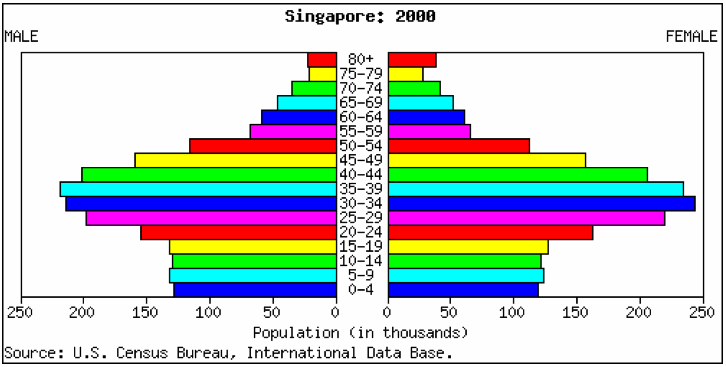
If you don't believe, just compare the numbers from the 3 pyramids below. E.g. In 2000, Singapore has just over 150K males and around 160K females aged 20-24 (red coloured bars). Five years later, in 2005, this age cohort now aged 25-29 (red coloured bars) has expanded to around 210K males and around 240K females -- an extra of around 140K from year 2000. Now, if you don't believe this increase is from immigration* and/or resident foreign labour (i.e. PRs), then please explain to me how to give birth to newborns that are instantly 25-29 years old. As for immigration, most people know anecdotally that being gainfully employed in Singapore is a common way to obtain permanent residency (PR). Anecdotal experience also suggests that an "invitation" to become a PR is automatically sent to the foreign worker if he/she holds an S-Pass or Employment Pass and has been gainfully employed in Singapore over a few years. 

Back to the charts. Another five years later, in 2010, this age cohort now aged 30-34 (red coloured bars) has expanded further to just over 250K males and around 300K females -- an extra of around 100K from year 2005. Or a total expansion of around 240K residents when comparing years 2010 and 2000. If you don't believe that the addition of around 240K people of the age group 30-34 (in 2010, cf. age 20-24 in 2000) is largely due to Singapore's liberal foreign workforce policies, then please explain what majority of those additional 240K new residents are doing in Singapore?
Note: The additional 240K new residents represent a 77.4% increase over the original 310K residents of that age cohort. Wouldn't the future potential support ratio issue (35 years down the road) be worsened by this 77.4% increase? Without such artificial increase in young working-adult age cohorts, would our population pyramid look similar to developed countries, like Canada?
2010 Singapore population pyramid,
source: Nation Master

2005 Singapore population pyramid,
source: Nation Master

2000 Singapore population pyramid,
source: Nation Master

Now if analysis of the above charts is still not convincing enough, then please read the numbers from the following table, sourced from the Migration Policy Institute. The number of citizens* grew by 244,833 from years 2000 to 2010. [Note: The growth in citizen numbers is a combination of the net birth minus deaths and the net number of new citizenships issued minus the number of citizenships surrendered.] In comparison, the number of PRs grew by 253,525 over the same period -- exceeding that of citizens! Once again, what is the most common way to become a Singapore PR?

 Changing Proportion of Citizens to Foreign Nonresidents in Singapore, 

While we are looking at the above table, please also note the total non-resident population numbers. It increased by 550,487 -- from 754,524 in year 2000 to 1,305,011 in 2010. Yes, we are talking about Employment Pass, S-Pass, and Work Permit holders. Employers are not required to pay CPF for these non-resident workers -- i.e. read, lower cost for employers. Neither do these non-resident workers have to contribute to CPF -- i.e. read, higher take-home pay for non-resident workers. How can the Singapore citizens and PRs compete against these non-resident workers to be cheaper?

[Aside: Please read the excellent article from the Migration Policy Institute from which the above table is sourced. "Rapid Growth in Singapore's Immigrant Population Brings Policy Challenges" by Brenda S.A. Yeoh and Weiqiang Lin, National University of Singapore, April 2012.]

------------------------------

p.s. When voting in an election, one should consider the effect of the party whip. Singapore citizens who "kao peh kao bu" (i.e. complain/lament) about the flood of foreigners amongst their midst are really shooting themselves in the feet when they vote for the political party that clearly indicates its plans to keep the floodgate open -- some of the 60% did it the last round, I believe. The "enemy" is within us.

Wednesday, January 09, 2013

Canadian Live-in Caregiver (Maid) Policy

I read this "Five men, like flotsam" article from Yawning Bread and wanted to share something about the similarities and differences in Canada.

Before I do that, I need to share a little about the background of the "Live-in Caregiver" policy in Canada (a.k.a. Domestic Maid in Singaporean lingo). The following is an email that I wrote to the Singapore Ministry of Manpower in June-2011 (in support of Kristen Han's "Campaign for a Regular Day Off for Domestic Workers"). 
[Aside, actually I also forwarded the email to a secondary school friend who (based on what she mentioned) was at some point the MOM officer who approved the renewal of work permits, including those of domestic maids. Note: I think she has moved on to another position within MOM since.]
Hopefully, the email will serve to provide a quick background of the rules and regulations surrounding the live-in caregiver (a.k.a. domestic maid) policy in Canada. [Click here for "A Guide to the Employment Standards Act For Domestic Workers and their Employers" by the Government of British Columbia.] I shall be mentioning "live-in caregivers" in Canada in my upcoming post regarding the issues brought up by Yawning Bread's article.

------------------------------

From: [WD]
Subject: Campaign for a Regular Day Off for Domestic Workers
To: mom_fmmd@mom.gov.sg
Date: Sunday, 26 June, 2011, 4:32 AM

Dear Sir,

I read with interest the Campaign for a Regular Day Off for domestic workers in Singapore.
http://www.maiddayoff.com/

I am in a Singapore Citizen currently residing in Canada. In my humble opinion, the Canadian system is not perfect, but even as it stands, there is so much that Singapore can adapt from Canada regarding its labour laws on domestic workers, otherwise known as live-in caregivers in Canada.

E.g. For live-in caregivers, the Canadian immigration have strict rules that all Terms & Conditions are clearly defined before the live-in caregivers are given the visa to land in Canada.
http://www.cic.gc.ca/english/work/caregiver/apply-who.asp

E.g. The following Employment Standards Rights for Foreign National Live-in Caregivers explain their rights to them. In multicultural Canada, government services may be rendered in the language of the client (including that of the foreign worker) as necessary so as to ensure their understanding of their rights and responsibilities.
http://www.labour.gov.on.ca/english/es/pubs/is_fn_esa.php
See section on “Limits on Hours of Work”. “For you to work more than 48 hours in a week, your employer must have your written agreement and an approval from the Ministry of Labour.”
“Generally, you must have at least 11 consecutive hours off work each day, and 24 consecutive hours off work each week, or 48 consecutive hours off work in every 2-week period.”

E.g. The URL below shows a template for the contract to be submitted to immigration department before the live-in caregiver is allowed to enter Canada. Point 8, regarding paid public holiday entitlement, states, “The EMPLOYEE shall be entitled to all applicable provincial, territorial and national statutory and public holidays with pay.”
http://www.cic.gc.ca/english/work/caregiver/sample-contract.asp

E.g. The following URL gives Human Resource directives on Live-in Caregivers. Point 4.7, regarding hours of work, states, “While some latitude may be expected, the work schedule cannot be flexible to the point that the caregiver is on call 24 hours per day. Employers must be aware that overtime must be paid to the live-in caregiver in accordance with provincial/territorial legislation. To learn more about the maximum acceptable number of hours, please refer to the relevant provincial labour standards”.
http://www.hrsdc.gc.ca/eng/workplaceskills/foreign_workers/lcpdir/lcpdir-4.shtml

Given Singapore's demand for high productivity and long work hours from our professional workforce, Singaporeans depend heavily on their domestic workers to run the homes and take care of loved ones. Given this dependency, wouldn't it be in our best interests to provide conditions where we can attract the best domestic workers to our shores in the same way that we seek to attract the best foreign talents to Singapore? In order to compete effectively, Singapore needs to raise its bar gradually but resolutely to meet international standards.

Yours sincerely,
[WD's full official NRIC name]

Tuesday, January 08, 2013

Being Cinderella's magic

Yesterday I went to a drop-off location to donate some items to "The Cinderella Project" in Vancouver.
Founded in 1999, "The Cinderella Project provides underprivileged high school graduates with formal attire so they can attend their graduation festivities with pride. Without assistance, these students could not afford to participate in celebrating this important milestone." - The Cinderella Project
Why did I donate?
  • First off, the project needed "very small sizes (0-2)" dresses and I happened to have a couple of dresses that I have outgrown. Yup, I am now about 1 to 1.5 inches wider in my waist than I was upon landing in Canada.
  • Secondly, I am reminded of how I ended up attending my JC prom night (i.e. social equivalent of Canadian high school graduation ball) in a blouse and skirt that matched the waitresses uniform for that night. Yes, being born-poor has social consequences. If you think that my experience was unique, look at Xianlong's comment on that blogpost. Quoting Xianlong, "U feel embarassed at your prom night, i'm even worse than you - i dare not attend although i've bought a long sleeve white shirt for the occasion."
  • It is my habit to regularly spring-clean to make space in my limited wardrobe space for new items. The 2 dresses reminded me of Mr SMS (long story). Anyway, time to let go of the past, the old me. I have an aunt who kept many of her clothes from over the decades. When I saw the piles of clothes in her bedroom years ago, the first thought I have was, "This is someone who cannot let got of her material possessions and/or her past. And possibly someone who is not confident of making/creating enough to meet her current/future needs."
"It’s about the dream, not the dress." - The Cinderella Project